AI gives me back the excitement of my early days as a developer
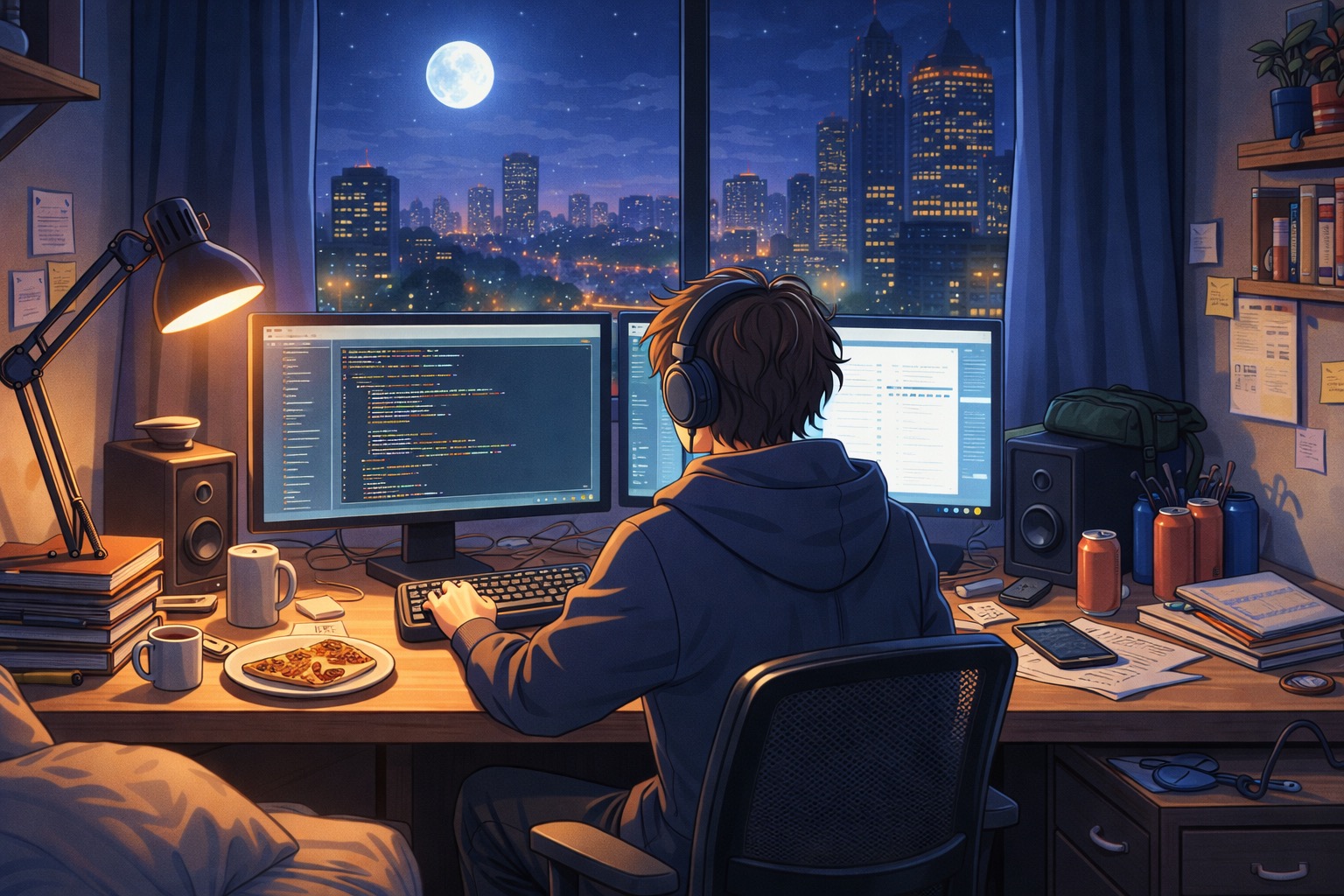
A few weeks ago, I found myself spending an entire night testing agents, refining prompts, failing, starting over, deploying, breaking things, rebuilding. And at some point, around two in the morning, I realised I was smiling. Not because it was working — it wasn’t, not yet — but because I was feeling something I thought I had lost a long time ago: the pure excitement of tinkering in the unknown.
Unlock the full article
Drop your email below and I’ll send you the rest right away.
A few weeks ago, I found myself spending an entire night testing agents, refining prompts, failing, starting over, deploying, breaking things, rebuilding. And at some point, around two in the morning, I realised I was smiling. Not because it was working — it wasn’t, not yet — but because I was feeling something I thought I had lost a long time ago: the pure excitement of tinkering in the unknown.
Late nights tinkering : memories of a web being born
About thirty years ago, I learned to build websites. Back then, the internet wasn’t what it later became. There was no Stack Overflow, no video tutorials, no exhaustive documentation a click away. We relied on forums, on the rare people around us who knew a thing or two, on sometimes laborious exchanges with strangers who were fumbling just as much as we were.
I spent entire nights in front of my screen. I coded, tested, failed, recoded, redeployed. I dug through English documentation I only half understood. I tried things without really knowing if they would work. And that was precisely what made it so thrilling: everything was left to do, everything was left to learn, everything was left to discover. There was a feeling of having a front-row seat at something enormous being built before our eyes — and partly by our own hands.
That period was formative for me. Not just technically, but in the way I approach problems, accept failure as a normal step, and find pleasure in the process as much as in the result.
Development had become too tame
Then the years went by. Technologies matured. Frameworks became robust, deployment pipelines reliable, patterns well established. What had once been artisanal exploration became a structured discipline, with its best practices, its conventions, its certainties.
I’m not saying that’s a bad thing. That maturity made it possible to build far more solid systems, to work in teams more effectively, to reduce risk. But honestly, something had been lost in that stabilisation. Software development had become, at times, almost boring. Predictable. You more or less knew what you were going to get before you even started. The space for surprise, for real exploration, had shrunk considerably.
I remember thinking, a few years back, that I had maybe seen it all. That the excitement of the early days wouldn’t come back, that it was simply a matter of youth and novelty, and that now the thing to do was to find excitement elsewhere — in scaling, in optimisation, in robustness. Real challenges, but of a very different nature.
AI : the exhilarating chaos is back
And then LLMs arrived — really arrived, not just as a topic to keep an eye on but as an everyday tool. And with them, something started moving again.
What strikes me most is the instability — and the fact that this instability is exactly what makes the moment so exciting. The certainties we had yesterday no longer hold today. What we think we understand today will be called into question tomorrow. Development cycles are short, versions follow one another at a frantic pace, paradigms shift before we’ve even had time to truly master them.
Everyone is fumbling. Everyone is experimenting. Everyone fails, and sometimes everyone eventually succeeds. You can feel that the technologies are maturing — but much faster than we were used to — and that in the meantime, nothing is set in stone. It’s uncomfortable and stimulating at the same time. It’s exactly the same feeling I had thirty years ago facing an internet that was still searching for its shape.
Tinkering again : Claude Code, OpenAI and the others
Over the past few weeks, I’ve spent a considerable amount of time exploring. Claude Code, OpenClaw, the various Anthropic models, OpenAI tools, autonomous agents, automation workflows — I’ve tested, broken, rebuilt, refined.
It’s time-consuming. It’s sometimes frustrating. But above all, it’s deeply satisfying. I’m rediscovering that specific pleasure of exploration: understanding how something truly works, not just on the surface, but in its mechanics. Refining prompts the way you once refined SQL queries. Building deployment processes that actually hold up. Finding the right workflows, the right ways to connect tools together.
What amuses me most is that even with technologies exponentially more powerful than in 1995, you find the same fundamental dynamic: you try things, you see what sticks, you understand why something breaks, you start again with what you’ve learned. The terrain has changed, the tools have changed, but the approach remains the same.
Community as fuel
Another aspect that resonates strongly with my memories is the collective dimension of exploration. Just as in the forum days when everyone shared their discoveries and their setbacks, I find today that same momentum in exchanges with colleagues and people engaged in the same pursuit.
Hunting online for solutions to the problems you encounter, sharing what works, discussing what doesn’t yet, comparing approaches — all of this recreates a form of collective intelligence that I find enormously stimulating. You sense that many of us are building something together, even without explicit coordination. Everyone pushes forward in their own corner, shares what they find, and the sum of it all ends up advancing the field much faster than any one person could alone.
Thirty years after my first late nights tinkering with HTML, JavaScript and PHP on a CRT monitor, I find intact that pleasure of exploring a territory that has no maps yet. The tools have changed in nature, the power is incomparable, but the essentials are there: productive uncertainty, unapologetic trial and error, the satisfaction of understanding something that nobody quite understood yesterday.
I have no idea where all of this is heading. And that’s precisely what keeps me up at night — in the best possible way.