Ten days in South Korea, between Seoul and Busan
Lyon — Paris — Seoul
The trip starts early at Lyon-Saint-Exupéry with an early-morning Lyon-Paris flight. Long stopover at terminal 2L in Roissy before boarding for Seoul. Daytime flight, landing at Incheon the next morning around 9:30 local time.
First hours in Seoul
First taste of Korean efficiency: buying T-money cards (the contactless transport cards, valid in the metro and in most convenience stores), then AREX, the express train connecting the airport to Seoul Station, and finally the metro (lines 4 then 3) to the hotel, right in the historic center. Room ready at noon — a good omen.
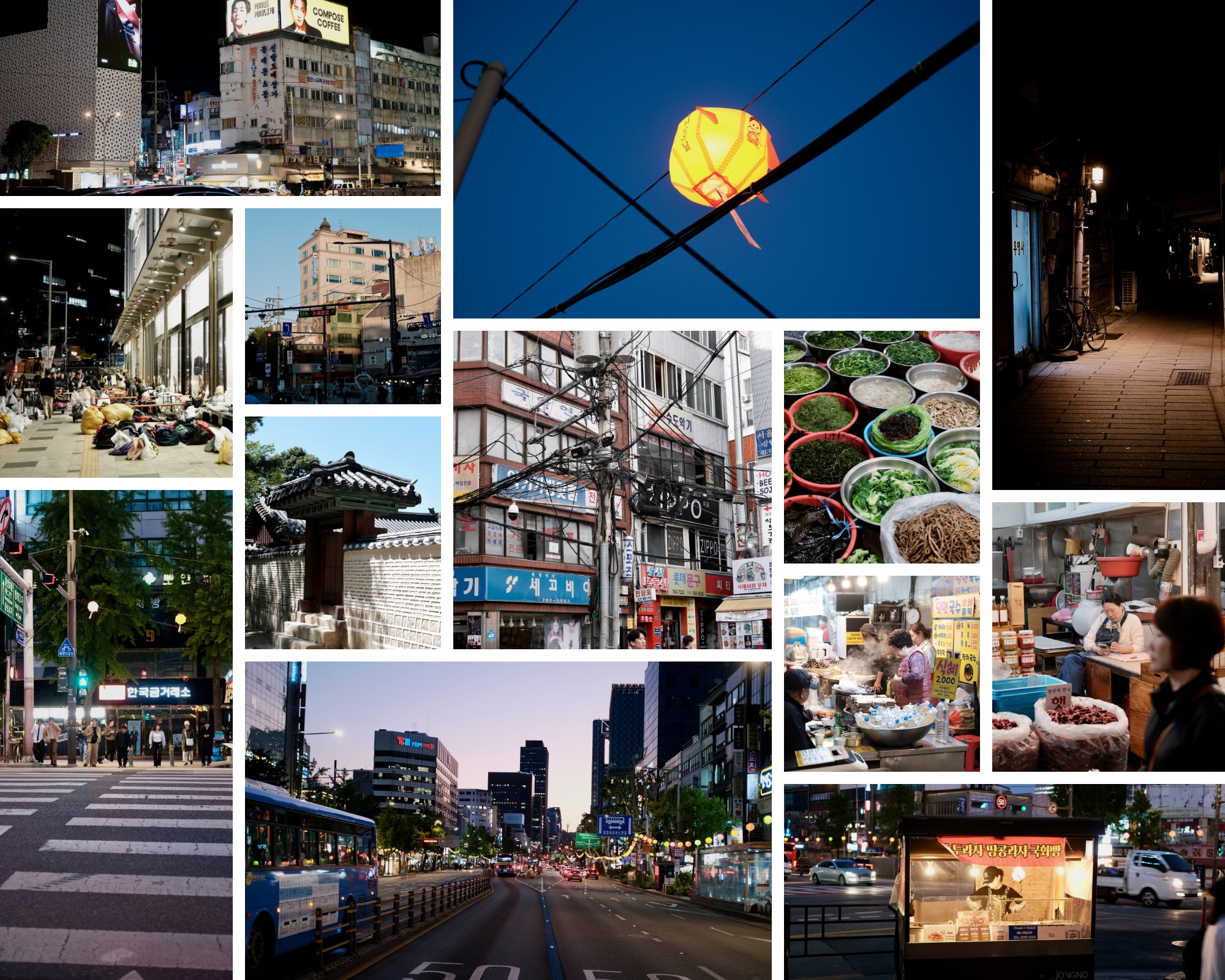
First meal in Korea in a tiny restaurant a stone’s throw from the hotel: udon, those thick Japanese noodles adopted by Korean cuisine. The stroll through the surrounding alleys is a real surprise — countless micro-shops, electrical wires crossing in every direction, smells of street food, an atmosphere reminiscent of India without the chaos. Everything is clean and orderly.
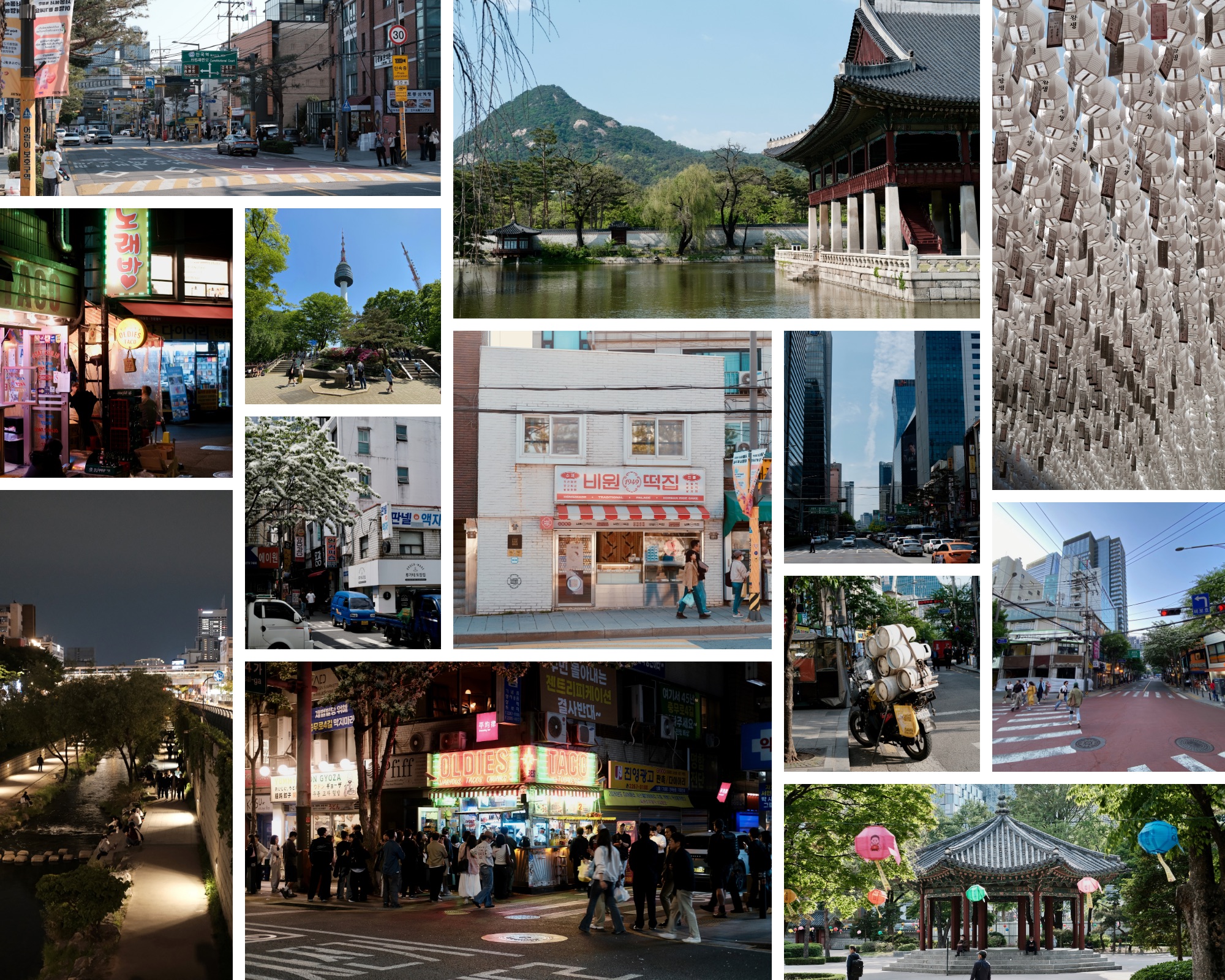
The afternoon unfolds along Cheonggyecheon, the restored stream that runs through the heart of Seoul below street level, and at the Jogyesa Buddhist Temple, an oasis of calm in the middle of the city. Snack of bungeoppang (붕어빵) — a fish-shaped pastry baked in a waffle-style mold and filled with sweet red bean paste — bought from a street vendor making them on the spot.
In the evening, dinner in the neighborhood (a kimchi chicken stew, served with rice) and the chance discovery of Mio Records, a record store tucked away in an unassuming alley. The downtown streets, beautifully lit at night, are absolutely worth a long wander.
Seoul: royal palaces and hanok villages
Off to Tongin-dong, a lively neighborhood full of cafés. Excellent lunch at vegan restaurant Maji, then a visit to Gyeongbokgung Palace, the great royal palace of the Joseon dynasty. The palace is teeming with visitors in hanbok — the traditional outfit rented all over the area — posing in front of the curved-roof pavilions.
Just nearby, Bukchon Hanok Village spreads up the slopes of a hill. The hanok, those traditional houses with grey tiles and slightly upturned roofs, lean into each other along narrow streets that open onto unexpected views of the modern city beyond. The area is touristy, but the atmosphere stays pleasant.
A striking detail about Korea: there are almost no public trash bins on the street, and yet the streets are spotless. Light strips embedded in the pavement signal pedestrian crossings, metro trains arrive playing a little brass-band melody, signage is covered with cute mascots. The country lives in a constant attention to detail.
To close the day, another walk along the Cheonggyecheon under its night lights, and a stop at a 24-hour convenience store — a Korean institution — to munch on some seaweed chips, a true revelation.
Seoul Tower and Myeong-dong
Heading to Namsan and the N Seoul Tower, reached from downtown by a steep walk up to the cable car station, then a few minutes above the canopy. An hour-long line, but the 360° view from the observatory is worth it: a city ringed by mountains, the Han River winding through it, and high-rises as far as the eye can see. At the railings, the inevitable heart-shaped padlocks left behind by couples.
At the foot of the tower: street food everywhere — coin-shaped cheese-stuffed waffles, multicolored beaded ice creams — before lunch in a traditional Korean restaurant: vegetarian bibimbap and its raw-beef tartare cousin, served with the customary banchan (small complimentary side dishes).
The afternoon is spent in Myeong-dong, the shopping district par excellence. The pedestrian streets are packed, with K-pop megastores like K-pop Friends and KMecca blasting music — records, caps, t-shirts, vinyls. Street food spills out everywhere: caramelized fruit skewers, sweet waffles, grilled sandwiches.
KTX to Busan
From central Seoul, the metro takes you to Seoul Station, a huge, slick terminal from which the KTX, Korea’s high-speed trains, depart. The technology comes from Alstom and the TGV reflexes kick in quickly. Three hours later, you’ve crossed the peninsula, watching the landscape roll past: green countryside, vast horticultural greenhouses, rice paddies, hills, and a final mountain range before the descent toward the south coast.
Busan: a trendy café and a drone show
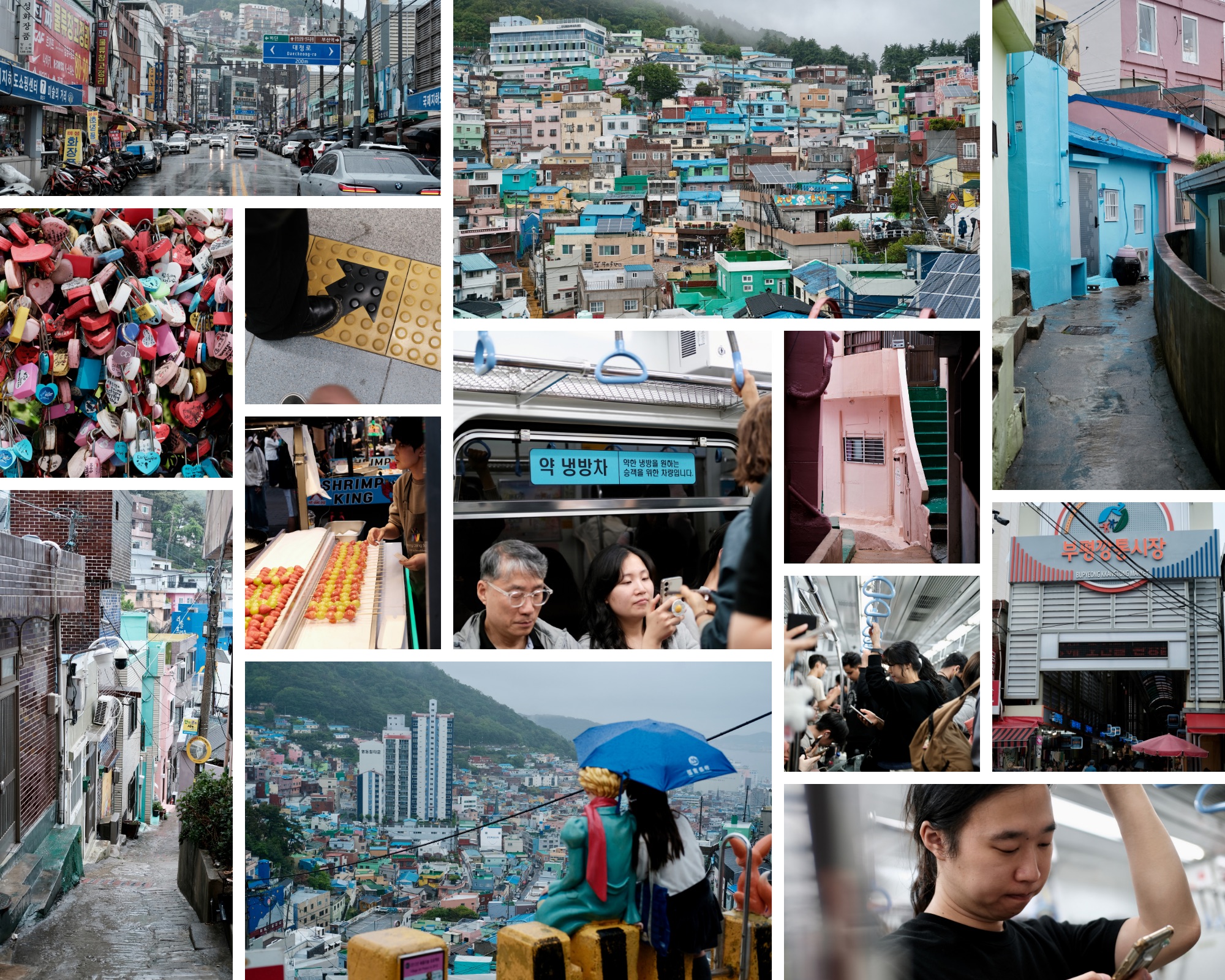
Arrival in Busan in the early afternoon. The local metro carries us to the hotel: the train arrival jingle here imitates seagull cries and the sound of waves, instead of Seoul’s little brass fanfare.
Snack at Lasoop, a three-level café — ground floor closed off, a half-covered terrace in the middle, and an open-sky rooftop with bleacher-style seating. Cheesecakes, artificial mist, plants — one of the city’s hippest addresses.
In the evening, metro to Haeundae Beach, Busan’s iconic shore. That night, the bay hosts a big drone show replayed every fifteen minutes: opening fireworks, a light-and-laser performance on the bridge closing off the bay, then about a thousand drones forming animated figures in the sky (Spider-Man, dragons, waves). The crowd is enormous, the seaside atmosphere at its peak.
Busan: Gamcheon, markets and Korean barbecue
The next day, metro and bus up to the Gamcheon Culture Village, a former hillside neighborhood of migrants. The colorful houses climb up the slope in tiers, the alleys are so narrow you can barely cross paths, and the whole thing feels like an open-air art installation. The morning’s pouring rain doesn’t ruin the view.
The afternoon is spent in the central markets. Gukje Market, the huge traditional covered market, is half-closed on a Sunday, but the neighboring Bupyeong Kkangtong Market is in full swing — textiles, fish, meat, dried fruits. A little further on, BIFF Square brings together international and Korean brands in a bustling pedestrian street. We walk past Jagalchi Fish Market, the country’s largest fish market, where you pick your fish on the ground floor and have it cooked and served upstairs.
Long stop at I Love Music Nampo, an entire block dedicated to music (CDs, vinyl, merchandise). Local curiosity: albums are also sold on USB sticks, for cars and home hi-fi systems.
In the evening, a proper Korean barbecue at Kkotttukkeong: a charcoal grill at the center of the table, an extractor hood above, and the meat — a Korean beef incredibly well marbled — grilled by the server, with rice, kimchi, soup, and all kinds of banchan. Probably one of the best meals of the whole trip.
Back to Seoul: Dongdaemun
KTX back to Seoul, with landscapes even greener than on the way out and many wide rivers that remind you how water-rich this country is. New hotel for the last three nights, next to another beautiful hanok village.
In the evening, visit to the Dongdaemun Design Plaza (DDP), a huge Zaha Hadid building with sweeping curves, clad in over 45,000 metallic panels and animated by LED light effects. Right next door, the Dongdaemun Fashion Mall is a world of its own: open until 5 a.m., it gathers across multiple floors hundreds of small stalls where wholesalers and retailers mingle, delivery workers weave between customers, Korean designers display their work, and jewellers livestream on TikTok.
Jongmyo, Changdeokgung and the hanok neighborhood
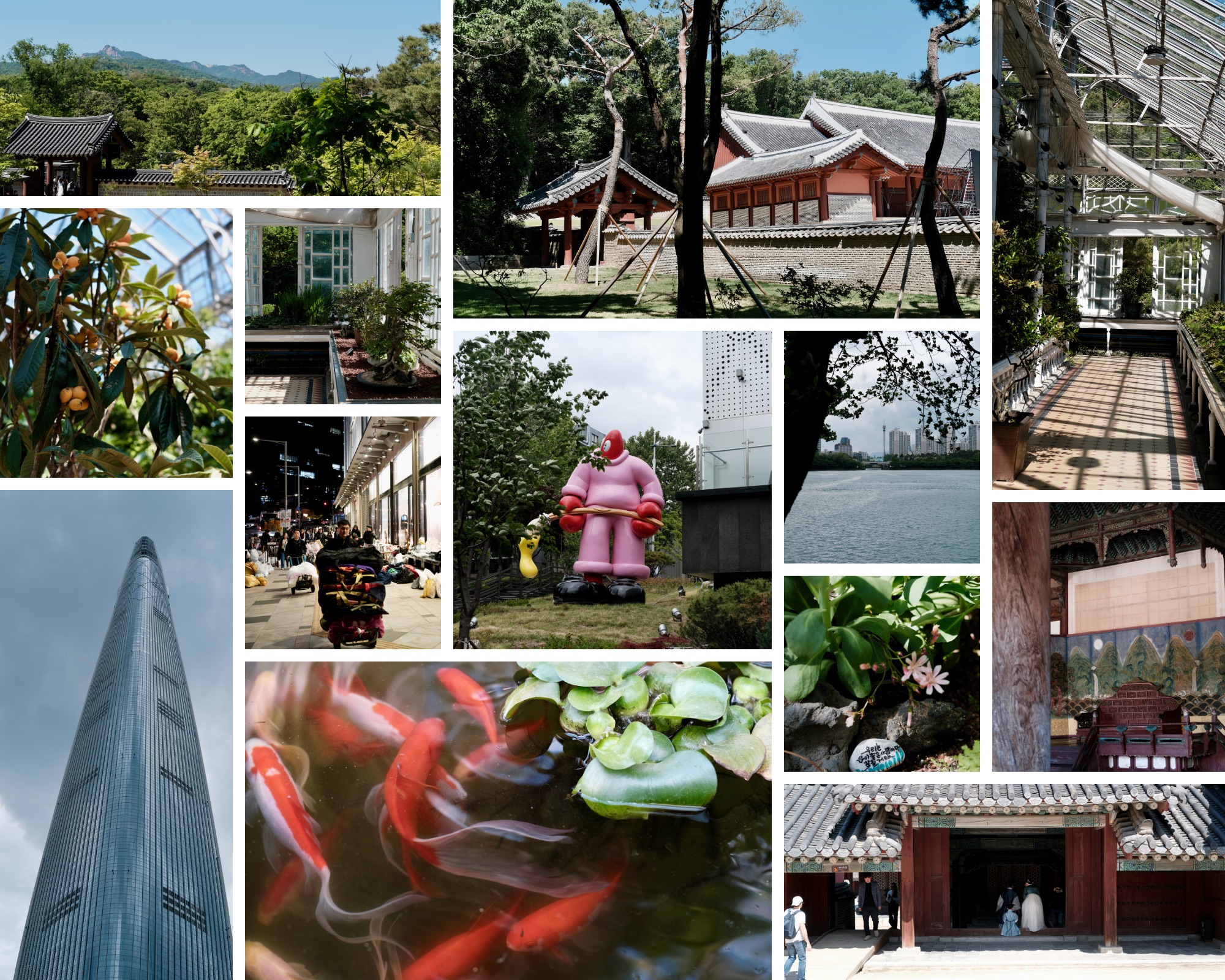
Brunch in a café set inside a traditional wooden house opening onto an inner patio planted with trees, then a visit to Jongmyo Shrine, a Confucian sanctuary nestled in a large wooded park — the first really shady park of the trip. Just nearby, on to Changdeokgung Palace, another great royal palace of Seoul, beautifully preserved and UNESCO-listed. You wander through a sequence of courtyards, pavilions and gardens, all the way to a stunning greenhouse housing bonsai, giant plants and fish ponds. Entry fees are ridiculously low (around 1,000 won — less than a euro).
Gangnam, libraries and vinyl
Off to the south of the city and the district of Gangnam, metro under the Han River. Mandatory stop in front of the Gangnam Style statue, two hands crossed like in the choreography, then a long visit to Starfield Library in the COEX mall: a giant library on six floors, with shelving rising all the way to the ceiling. The books aren’t for sale — people simply come here to read or work.
In the same mall: the COEX Aquarium, surprisingly large, with otters, sharks and axolotls. Funny detail: you keep coming across local chains with very French branding — Paris Baguette, Café de Lyon — and a coffee shop literally every 200 meters.
In the afternoon, on to Itaewon, the district of embassies and luxury boutiques, home to Hyundai Vinyl, a beautiful record store with an immense Korean, Japanese and international selection. A great touch: you can pick three records and listen to them on the spot for 30 minutes on one of the in-store turntables.
Lotte World Tower and flight home
For the last day, metro to Lotte World Tower, a 555-meter skyscraper, one of the tallest in the world. At its base, two artificial lakes ringed by a large garden you can loop on foot, and the Lotte World theme park with its little Disney-like castle squeezed between the high-rises. The Lotte World Mall, on seven floors, offers luxury brands on one side and XXL versions of popular ones like MUJI on the other.
Back to Seoul Station under pouring rain, then AREX to Incheon airport, crossing a landscape of lagoons and sandbanks just before landing.
In short
South Korea, in a few words:
- Transport of formidable efficiency — metro, dedicated-lane buses, KTX, AREX, all paid for with a swipe of a T-money card you can top up in any convenience store;
- A culture of detail and care: pedestrian crossings lit from the ground, little melodies in the metro, cute mascots on shop fronts, roadworks signs and even beer cans;
- An extraordinary food scene if you love meat — bibimbap, Korean barbecue, kimchi stews, street food on every corner — though it can quickly become a challenge for vegetarians outside of larger restaurants;
- Vibrant cities where pop culture (K-pop, manhwa, drama) coexists with centuries-old royal palaces and perfectly preserved hanok villages;
- A green, hilly country ringed by mountains you sense everywhere, and that we didn’t have time to go and hike.
We leave with a strong urge to come back — this time to explore the nature, the coast, the national parks and the Seoraksan range.